


The difference between a title and an early exit at tournaments often comes down to what happens off the court. Enter Helen Murawska, Aryna Sabalenka’s physiotherapist, whose work operates in a high-stakes yet often invisible corner of elite performance. Speaking with Women’s Tennis Blog at Indian Wells, Murawska offered insight into the role she plays within the world No. 1’s team, explaining that it “kind of floats somewhere between the preparation and the recovery.”
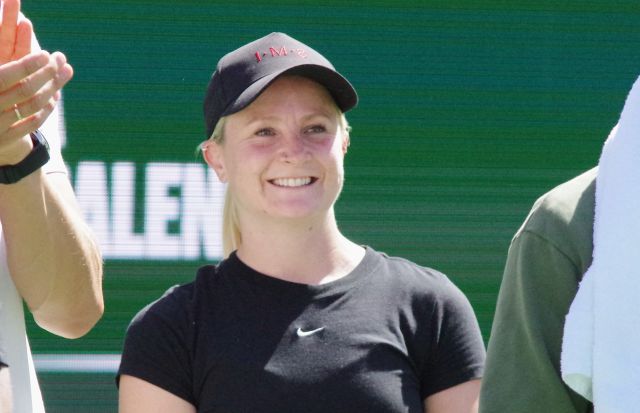
Murawska’s journey to the top of the tennis world wasn’t a straight line. With a background that jumps from clinical settings to touring with world-famous musicians, she brings a “problem-solving” energy to Sabalenka’s camp. “I’ve worked in a mixture of sports team environments, clinical work, and then touring with artists, singers, and musicians,” she says.
While some might find the repetitive demands of a singles sport dull, Helen thrives on the granular detail required to keep a world-class athlete at the top: “It tends to be higher-level and higher-end performance, so you’re really looking for the one-percent differences a lot of the time. It’s a lot of problem solving, which I love.”
Supporting a global star like Sabalenka isn’t a 9-to-5 job; it’s a lifestyle dictated by flight paths and media cycles. “Sometimes we’ve done treatment at 3AM after landing somewhere, and that’s the only time we can do it,” Helen reveals. “We can’t neglect it, because it’s important. At this level, she can’t really neglect anything. We have to consider lifestyle-wise factors and day-to-day routine. We have to just do what we can. Sometimes it’s a bit on the fly, given the environment we’re in.”
Getting those small gains is a group effort for Team Sabalenka, and Helen’s role is tightly intertwined with what Anton Dubrov and Max Mirnyi are doing on the court: “I need to know what Anton wants her to do on the court, and what Max wants her to do when she’s going to serve, so I can know: does that affect what I need to prepare her for, even if it’s just looking at a couple of small muscle groups that seem like they’re too tight or not active enough, and really fine-tuning her mechanics and her movement before she’s going to play, and then making sure that we’re not over-treating. I’m not overstretching. I’m not overactivating something.”
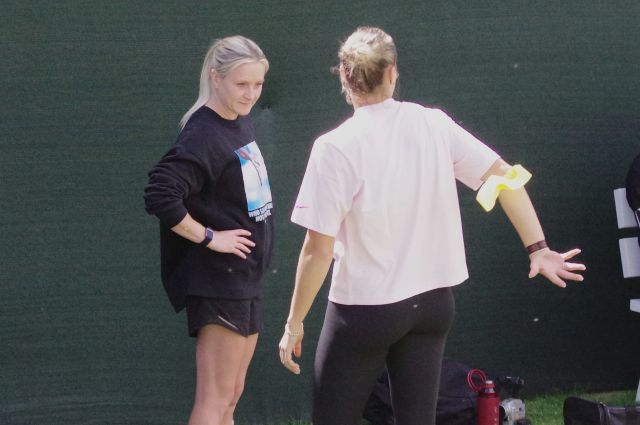
The world number one uses her Whoop band to track everything from sleep quality to recovery zones, and the team has access to the data, allowing for further adjustments along the way. The data also provides insights into what Helen told Women’s Tennis Blog might have surprised her most when she first joined the team: “The fact that she’s a really good sleeper. She’s the busiest person I know with everything that she gets asked to do and she’s always going deep in tournaments. You could imagine that she has trouble switching off at night or even calming down and being able to just drift into sleep.” The physio joked, “Maybe she has a button somewhere I don’t know. It’s rare for her to have a bad night sleep.”
The results speak for themselves. Sabalenka captured her first BNP Paribas Open title in a grueling three-set battle against Elena Rybakina. Reflecting on the match, she told reporters, “It was super hot. I was dying there in the tiebreak, but I also saw that she was also not feeling her best. So I was trying to push myself basically to the limit.” It was those small advantages earned off the court that made the difference, allowing her to push that limit just a little further.
Sabalenka is now through to the semifinals of the Miami Open, where she will face Rybakina once again.