

The ITIA published its full report on Marketa Vondrousova‘s four-year doping ban on Friday, and the 48-page document reveals a number of startling details. Among them are shocking text messages the former Wimbledon champion sent to her boyfriend, which appear to undermine her claim that she refused to meet a doping officer because of fear and anxiety.
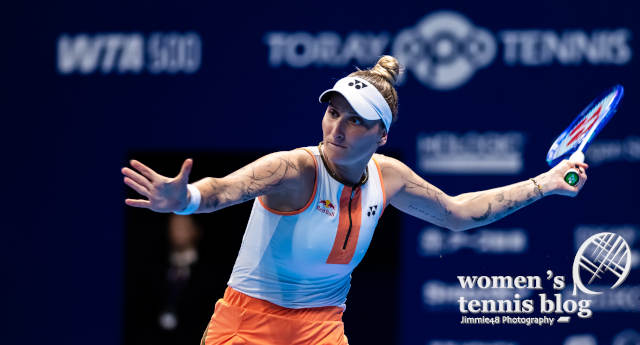
The lengthy report details the circumstances surrounding Vondrousova’s refusal to undergo doping control and explains why the tribunal rejected her anxiety-based defense.
On December 3, 2025, an anti-doping officer arrived at the Czech star’s home to conduct an out-of-competition test during the offseason. Vondrousova refused to provide a sample, insisting that she could not be tested outside the one-hour time slot she had specified in her whereabouts filing.
However, the tribunal concluded that she knew the visit was for an anti-doping test, noting that she had already undergone 83 doping controls during her career. After being warned of the consequences of refusing the test, she signed the official form confirming her refusal.
Later that evening, Vondrousova addressed the incident in an Instagram Story. Investigators also examined her conversations with her boyfriend, fellow Czech tennis player Andrew Paulson, and her agent. According to the report, “At 8:05pm, the Player sent a text message on WhatsApp to her boyfriend, Andrew Paulson, who is also a Czech professional tennis player. The message, translated into English, read:
So like here is ringing some c**t from the doping.
A few hours later, the 2023 Wimbledon champion realized that anti-doping officials were permitted to test her outside her designated one-hour slot. She then contacted another doping control officer she knew and arranged to be tested on December 7. That sample came back negative.
Vondrousova argued that she felt particularly vulnerable because of the years of threats she had received, as well as the knife attack on fellow Czech tennis star Petra Kvitova in her own home in 2016. She maintained that she was not attempting to evade testing, explaining that months of physical and mental strain had left her feeling unsafe about opening the door to a stranger.
However, the independent tribunal rejected that defense, finding that the evidence presented provided “no compelling justification” for refusing the test. As a result, Vondrousova was handed a four-year ban, with the newly released report setting out the tribunal’s reasoning in detail.
The ITIA defended the severity of the sanction by stressing that refusing a doping test is treated as a serious anti-doping violation, equivalent in terms of consequences to returning a positive result. The organization argued that imposing anything less than the maximum penalty could set a dangerous precedent and potentially encourage athletes to avoid testing.
The 27-year-old Vondrousova now has 21 days to appeal the suspension to the Court of Arbitration for Sport (CAS). If the decision stands, her four-year ban will remain in effect until June 21, 2030.
While there is little debate over the fact that she knowingly refused to take the test, opinions remain divided over the reason behind that decision. Some believe it was a case of arrogance or poor judgment, while others suspect it may have been an attempt to avoid a positive result. (source: Tennis Temple, photo: Jimmie48)